

Table of Contents
Relevant: Discount Rates Articles
WACC Formula
The weighted average cost of capital (WACC) estimates a company's discount rate by weighting the cost of each financing source by its proportion in the capital structure:
rWACC = wd × rd × (1 - tc) + wp × rp + we × re
where:
- w = weights
- r = costs
- d = debt
- p = preferred shares
- e = equity
- tc = corporate tax rate
The debt component includes a tax adjustment because interest payments are tax-deductible.
Market Value Weights
Determine the company's capital structure by calculating the market value of each component, then divide each by the total to get percentage weights.
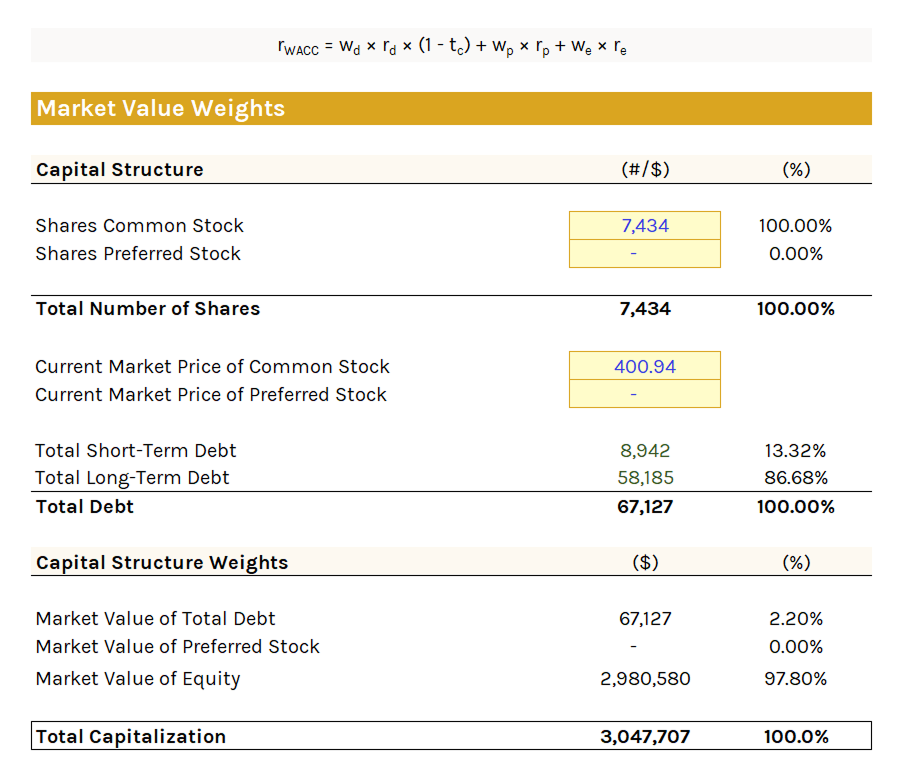
Market Value of Total Debt
Short-term + long-term debt (includes leases) from the balance sheet for the selected Analysis Year.
Market Value of Preferred Stock
Most companies don't issue preferred shares, so this often equals zero. If issued, check the shareholders' equity section of the balance sheet.
Market values can be found on Yahoo Finance or Preferred Stock Channel.
Market Value of Equity
Shares outstanding × current stock price.
Use shortcuts "=Stock_SharesOutstanding" and "=Stock_Price"
Cost of Capital
Calculate the cost of each capital component—what the company pays investors for using their capital. Each source carries a different cost based on its perceived risk/return and tax treatment.
Cost of Debt
Cost of debt represents what lenders expect to earn for providing capital.
Calculate the pre-tax cost of debt using one of the two methods below, then apply the tax shield.
Method #1: Synthetic Rating
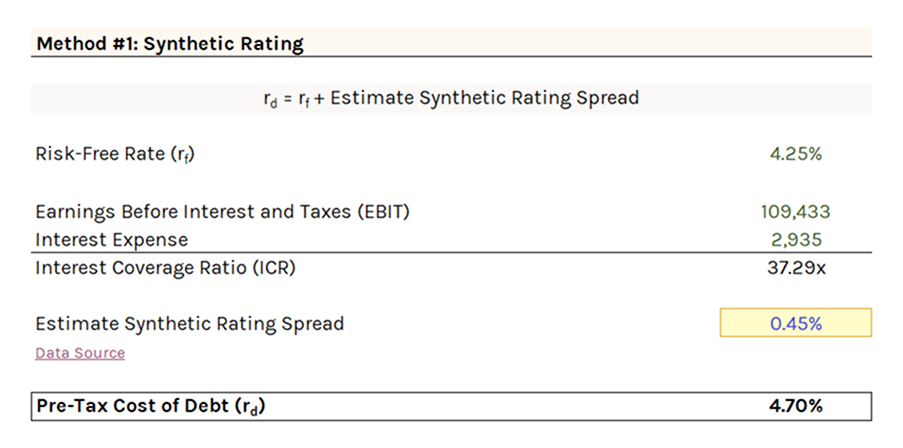
Based on Professor Damodaran's approach. Uses the interest coverage ratio to estimate a synthetic credit rating and default spread.
rd = rf + Estimate Synthetic Rating Spread
where:
- rd = pre-tax cost of debt
- rf = risk-free rate
Steps:
- Calculate interest coverage ratio: EBIT / Interest Expense.
- Match to the implied credit rating and spread using Damodaran's tables.
- Enter the spread in the input cell. Add to the risk-free rate to get pre-tax cost of debt.
Method #2: Interest Expense to Total Debt
rd = Interest Expense / Total Debt
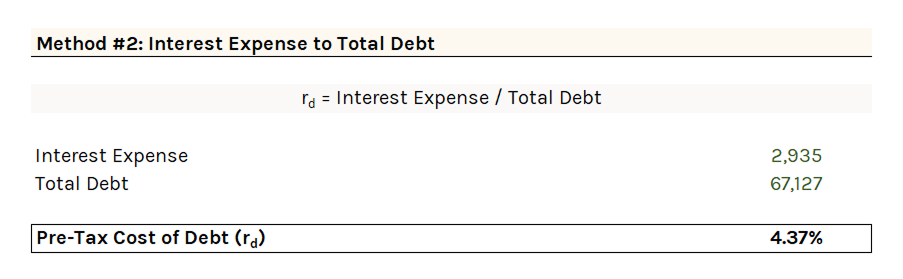
Simplest method but less accurate—doesn't account for varying maturities or risk profiles across debt instruments.
After-Tax Cost of Debt
After calculating the pre-tax cost of debt, apply the tax shield since interest payments are tax-deductible:
After-Tax Cost of Debt = rd × (1 - tc)
where:
- rd = pre-tax cost of debt
- tc = corporate tax rate
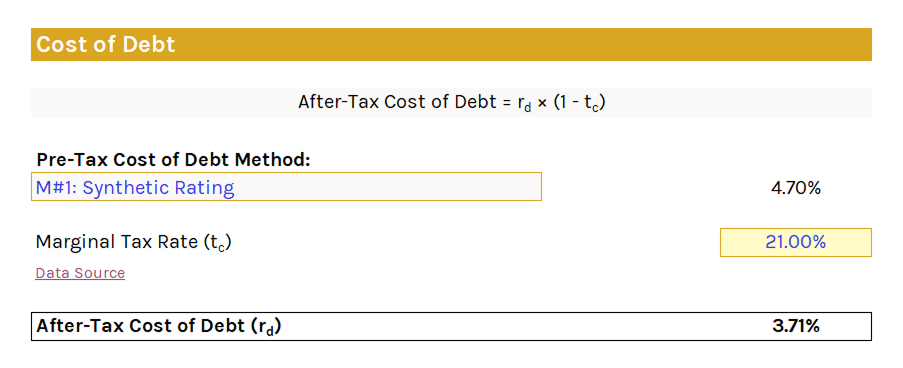
The tax rate should be the marginal tax rate (21% for U.S. companies). Marginal is preferred over effective (income tax expense / EBT) because the effective rate can be distorted by tax credits, deferred taxes, and other accounting practices.
Cost of Preferred Stock
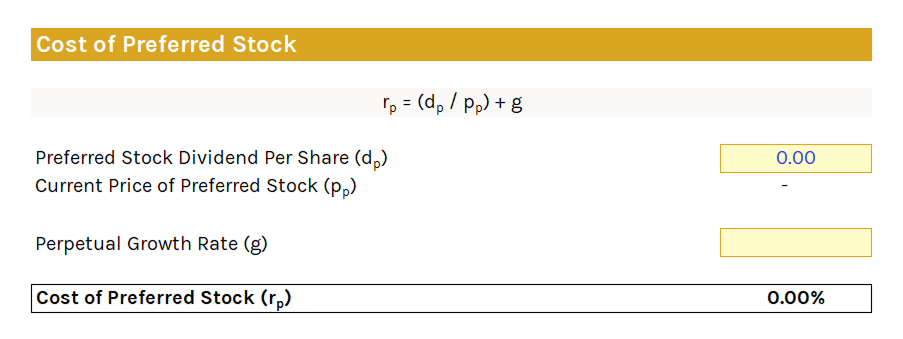
rp = (dp / pp) + g
where:
- rp = cost of preferred stock
- dp = preferred stock dividend per share (from Preferred Stock Channel).
- pp = current price of preferred stock (from market value weight section).
- g = perpetual dividend growth rate (leave blank if dividend is fixed).
No tax adjustment needed as preferred dividends are not tax-deductible.
Cost of Equity
The capital asset pricing model (CAPM) calculates cost of equity by linking systematic risk to expected return.
Standard CAPM:
re = rf + β × (rm - rf)
where:
- re = cost of equity
- rf = risk-free rate
- β = beta
- rm = expected market return
Modified CAPM (captures additional risk factors):
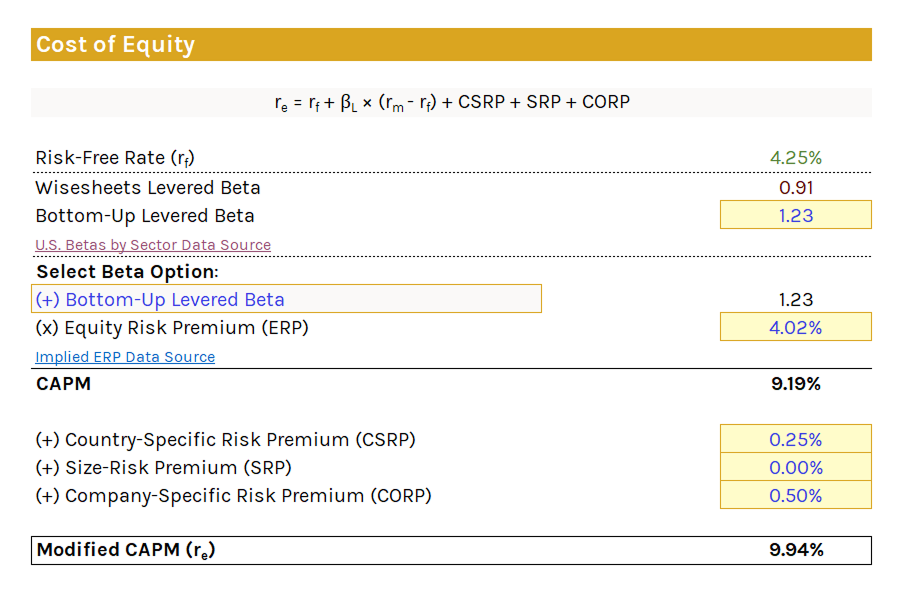
re = rf + β × (rm - rf) + CSRP + SRP + CORP
where:
- CSRP = country-specific risk premium
- SRP = size-risk premium
- CORP = company-specific risk premium
Beta Options
- Wisesheets Levered Beta: Levered beta provided by Wisesheets. Measures stock volatility including the effects of the company's debt (both business risk and financial risk).
- Bottom-Up Levered Beta: More accurate. Unlevers and relevers betas based on comparable companies to isolate pure business risk, then adjusts for the target company's capital structure. For quicker analysis, reference Damodaran's Betas by Sector page.
Equity Risk Premium (ERP)
ERP is the additional return investors expect for stock market risk over risk-free investments.
Damodaran calculates an implied ERP for U.S. stocks, updated monthly. The implied premium reflects current market conditions and is more accurate than historical averages.
Additional Risk Premiums
- Country-Specific Risk Premium (CSRP): For companies operating in countries with higher political, economic, or currency risk. Spreads available on Damodaran's website based on sovereign credit ratings and equity market volatility.
- Size-Risk Premium (SRP): Compensates for higher risk in smaller companies due to limited resources, market access, and operational scale.
- Company-Specific Risk Premium (CORP): Captures unique risks not reflected in beta—customer concentration, key person dependency, regulatory uncertainty, competitive threats. Most subjective of the three.
These additional premiums are optional but improve accuracy by capturing risks the basic CAPM overlooks.