

In a 2025 study, researchers had people choose between a stock and a bond, the safer of the two. Then they showed everyone the stock’s results for 12 rounds, one at a time, each round a gain or a loss.
A week later, the people who had chosen the stock remembered 23% more gains than they had actually seen, and 10% fewer losses. The people who were asked right away misremembered less than half as much.
That rosier memory also changed what they did next. A week later, 42% of the people who had chosen the stock invested in the same stock again, even though the results they had seen showed they should’ve switched to a bond. When people decided right away, that share was only 21%.
The researchers call this kind of memory a positive memory bias. Put simply, people remember the investments they chose as having performed better than they actually did.
Those were experiments, not real portfolios. But the decision those participants made is a lot like one most stock investors have faced, which is whether to put more money into a stock they already own, based on how they remember its performance.
Below, I’ll walk through how the researchers set up their first experiment, what people remembered, and how memory changed their decisions and their confidence. Then I’ll explain why memory works this way, what studies of managers and day traders found, and how to avoid the bias in your own investing.
How the First Experiment Worked
The study is called Investor Memory, and it was published in the Review of Financial Studies in 2025 by Katrin Gödker of Bocconi University, Peiran Jiao of Maastricht University and Paul Smeets of the University of Amsterdam. Together, they ran three experiments with 1,214 people.
In the first experiment, 229 people, mostly business and economics students at the University of Hamburg in Germany, came into a lab for two sessions, the second one a week after the first.
Each of them chose between two investments for 12 rounds:
- Bond: Paid a fixed €3.10 per round.
- Stock: Either gained €11-15 or lost €1-5 each round.
The stock could be a good stock or a bad stock, with a 50% chance of each, and nobody was told which kind it was. A good stock had a 60% chance of gaining each round. A bad stock had only a 40% chance.
After they chose, everyone watched the stock’s 12 results, one at a time, each shown for 2 seconds. Then, without any warning, the researchers asked everyone how many gains and how many losses they had seen, and right answers could earn them money.
Some people were asked right away, and others were asked a week later, when they came back to the lab. The researchers chose at random who answered when.
Second Decision
The people in the experiment were also asked to estimate the chance that the stock was a good stock. For their second decision, they could invest in the same stock for 12 more rounds, or in a second bond that paid a fixed €5.10 per round.
The second bond paid more than the bad stock earned in an average round, but less than the good stock:
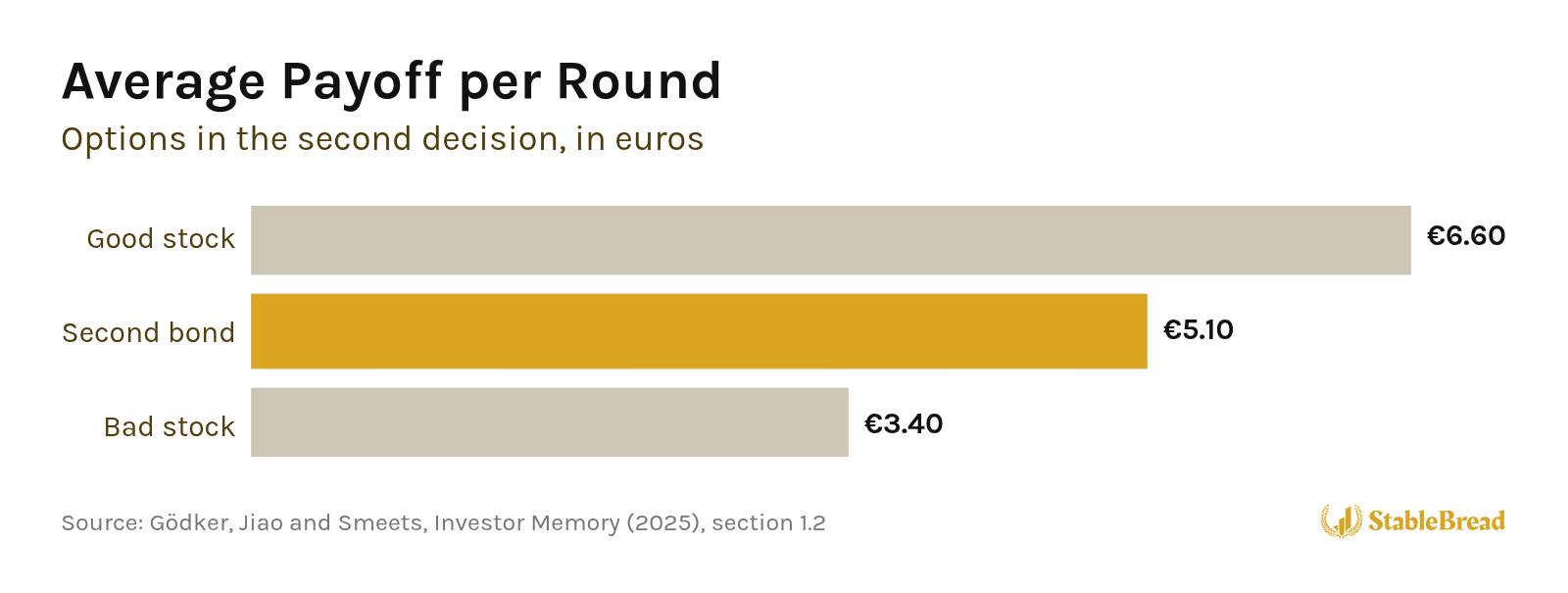
So the better option came down to how likely it was that the stock was good. Since a good stock gains more often than a bad stock, every gain was a small clue that the stock was good, and every loss was a clue that it was bad.
If someone saw 6 gains and 6 losses, the clues canceled out, and the stock was still just as likely to be good as bad. At that 50% chance, the stock would earn €5 in an average round, less than the second bond’s €5.10, so switching to the bond was the better option.
With 7 gains and 5 losses, the chance that the stock was good rose to 69%, since a good stock is more than twice as likely as a bad stock to produce 7 gains and 5 losses. At that chance, the stock would earn ~€5.60 in an average round, more than the bond’s €5.10, so sticking with the stock was the better option.
Basically, all anyone had to do was remember how many gains they had seen. With 7 or more, they should’ve stuck with the stock, and with 6 or fewer, they should’ve switched to the bond.
That’s why remembering even one gain that never happened mattered. Someone who saw 6 gains but remembered 7 would think the stock was the better option when it wasn’t.
Get Our 50-Question Stock Analysis Checklist!
After researching hundreds of stocks, we built this 50-question checklist to guide your analysis and help you avoid costly mistakes.
Download ChecklistWhat People Remembered
A week later, the people who had chosen the stock remembered more gains and fewer losses than they had actually seen, on average:
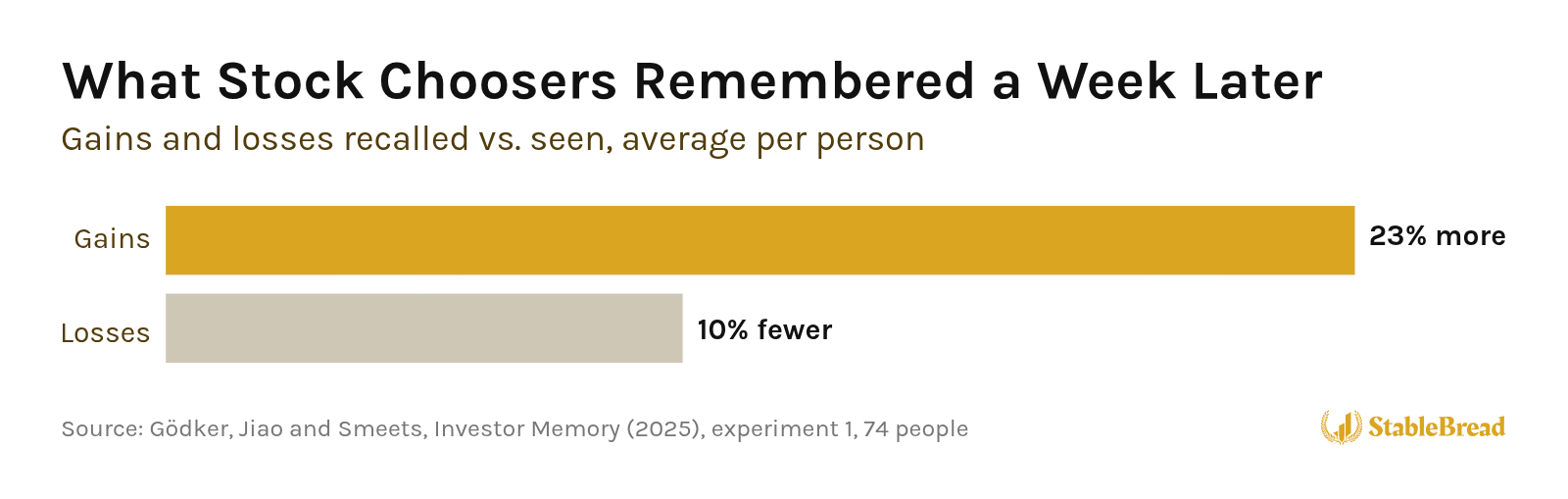
The people who answered right away made the same kind of mistake, but their errors were less than half as big. So most of the error built up in people’s memory over the following week, not while they watched the results.
Misremembering the results also changed what people believed about the stock. A week later, their estimates of the chance that they had a good stock were 8 percentage points too high, on average. That’s like answering 58% when the correct answer, based on the results they had seen, was 50%.
The people who misremembered the most also gave the most optimistic answers, and that optimism carried into their second decision.
How Memory Changed Their Decisions
When the people in the experiment made their second decision, sticking with the stock was only the better option if they had seen at least 7 gains. Yet a week later, 42% of the people who had chosen the stock stuck with it even though they had seen 6 gains or fewer, twice the share of those who decided right away:
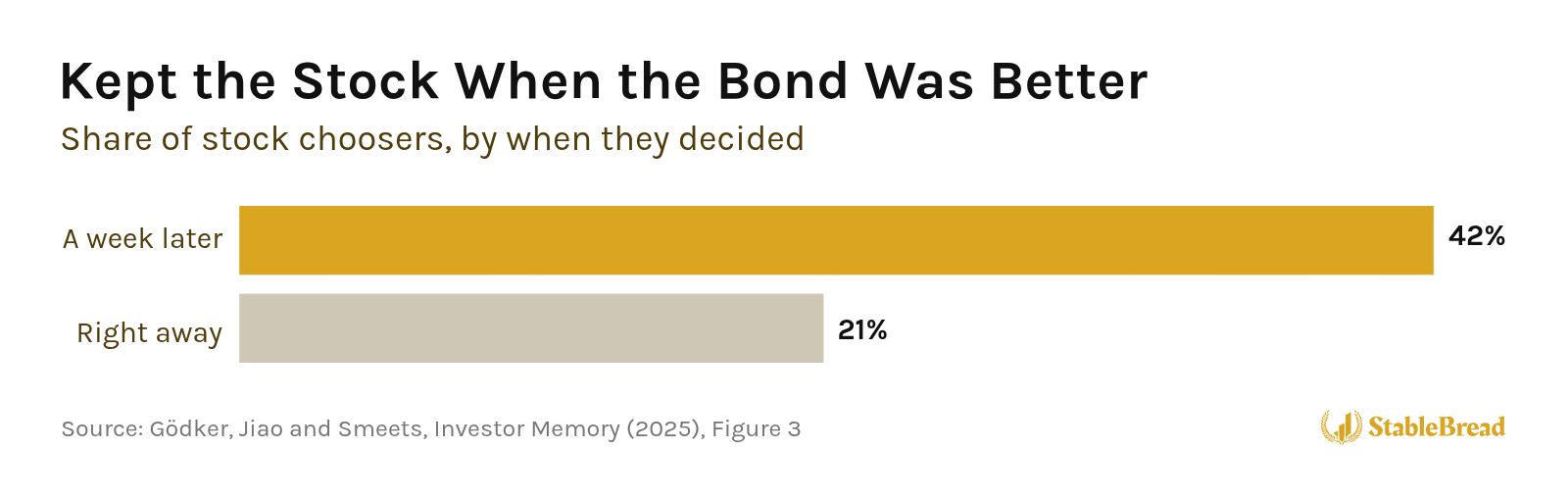
The people with the biggest memory errors were also the most likely to make that mistake. So deciding from a week-old memory doubled the share of people who put money back into the worse option.
Note: “Better” here means the higher average payoff. An investor who dislikes risk would need even better odds to choose the stock, so more of these choices would count as mistakes.
How Memory Changed Their Confidence
In another experiment, run online with 487 adults in the UK, the researchers tested whether a rosier memory also makes people more confident in their own stock choices. Before choosing between two stocks, people saw how each one had performed over the previous three rounds. Then they watched the next 12 rounds of the stock they chose.
A week later, they were asked to bet on whether they had chosen the better of the two stocks. Each person got 100 points and could bet as many of them as they wanted, in a group of 10 people.
The bet worked like the betting pools at horse races. If you had chosen the better stock, you got your points back, plus a share of the points lost by the people who hadn’t. If you had chosen the worse stock, you lost every point you bet.
So if you thought you had probably chosen the worse stock, the smart bet was 0.
The researchers chose at random who could see their stock’s full record of 12 results while they bet, and who had to rely on their memory. Among the people who, based on everything they had seen, had chosen the worse stock, those betting from memory bet 47% more:
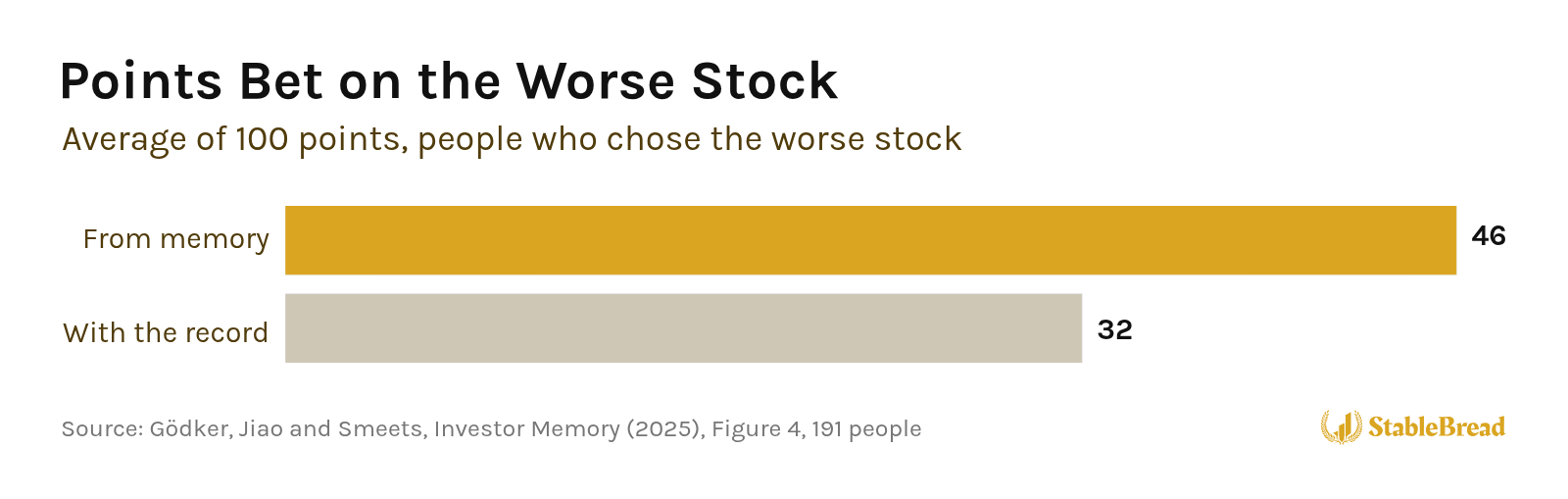
With the record in front of them, they still bet 32 of their 100 points, on average. Relying on their memory, they bet 46 points.
So the rosier memory made people more optimistic about their stock and more confident in their own choices, including the wrong ones.
Why Memory Works This Way
The researchers’ explanation for why memory tilts toward the gains on investments people chose themselves is motivated memory, remembering what happened in a way that helps you feel good about yourself. When the results come from a stock you chose, the gains say you chose well, and the losses say you didn’t.
To test that explanation, the researchers ran one more experiment online, with 498 students from the University of Oxford and the University of California, Berkeley. This time, people chose between two stocks instead of a stock and a bond.
Test #1: Bigger Rewards
If people had truly forgotten their losses, paying them more to remember shouldn’t bring the losses back. So for some of them, chosen at random, the researchers raised the reward for a right answer on the memory test from $8 to $50 (or from £8 to £50 at Oxford).
A week later, the people with the bigger reward remembered less than a third as many extra gains as those with the usual reward, few enough that the difference from what they saw could’ve just been chance.
So the losses weren’t erased. The losses were still in people’s memory, just harder to bring up when there wasn’t a strong reason to.
The bigger reward only made a difference for people who scored above average on a psychology survey that measures self-deception, or how much people overrate themselves without noticing. In other words, the money worked on the people who were most likely to bend their memories to feel good.
Test #2: Stocks They Didn’t Choose
If the bias comes from protecting your own decisions, it should go away when there’s no decision to protect. So for another group, the computer chose their stock at random. A week later, that group remembered only half as many extra gains as the people who chose their own stock, also few enough to be chance.
Psychologists call memory that favors your own choices choice-supportive memory. In studies published in 2000 and 2003, people remembered the options they had chosen more positively than the ones they had been given.
Interestingly, right after watching a stock they hadn’t chosen, people remembered fewer gains than they had actually seen. The researchers say the result fits other research finding that when people have no reason to protect themselves, bad news grabs more of their attention than good news.
Knowing more about finance didn’t protect people from the bias, either. People who did better on a question testing their financial knowledge misremembered just as much.
So the bias seems to come from protecting people’s own choices, not from a bad memory.
Managers and Day Traders
Rosier memories also show up when real money and careers are on the line.
In a 2022 study in the American Economic Review, economists David Huffman, Collin Raymond and Julia Shvets looked at managers who competed in the same contest again and again, with their pay depending on how they ranked against the other managers. After every contest, each manager was told where they ranked.
The managers remembered their past rankings as better than they actually were, and the ones with the rosiest memories made the most overconfident predictions about where they’d rank next. So even with feedback after every contest, their memories kept their confidence too high.
Plenty of investors also keep trading after losing money. In a 2020 study of day traders in Taiwan (people who buy and sell stocks within the same day), 74% of all day trading was done by day traders with a history of losses.
Related: Why Most Investors Underperform the Market
The memory study’s researchers argue that the positive memory bias can help explain why so many losing traders keep trading. As the researchers put it:
“If investors forget their losses, they cannot learn from their failures.”
— Gödker, Jiao and Smeets, Investor Memory
Study’s Limits
Granted, the memory study’s experiments lasted a week, the rewards were small, and most of the people in them were students.
The researchers note that real investors have more money riding on remembering correctly, but also more pride riding on being a good investor. So the study can’t say how big the bias is in real portfolios, and the researchers list that question for future research.
The stocks in the experiments also moved in small, everyday ups and downs, not crashes. Psychologists have found that people can remember big, emotional moments unusually well, so a crash in a stock you own may not fade from memory the same way.
How to Avoid This Bias
The simplest way to keep your memory from flattering your own stock picks is to check the record, as the betting experiment showed. When the people who had chosen the worse stock could see their stock’s full record of 12 results, they bet about a third less on being right.
Before I add to a stock I already own, I’d look up:
- The price I paid.
- How the stock has performed compared with the market since then.
- Whether the company has done what I expected when I first bought shares.
When you buy a stock, it also helps to write down why you’re buying the company and what would make you sell. That way, you have a record to check later, not just a memory.
All of this might sound obvious, but you’re probably well aware of how many investors don’t remember why they bought a stock in the first place. Instead, they decide whether to buy more based on how they remember the stock performing recently, and as this study found, that memory tends to be rosier than what actually happened.
However, even having the record in front of you won’t remove the bias completely. When people bet on their stock choices with the full record in front of them, the ones who had chosen the worse stock still bet 32 of their 100 points on being right, even though the smart bet was 0.
The researchers also suggest that reminders of what actually happened are likely to work better than teaching people about the bias. The researchers’ own results back the suggestion, since knowing more about finance didn’t make people’s memories any more accurate.
So the next time you think about adding to a position, open the record before you trust the memory.
