

In 1988, Berkshire Hathaway started buying Coca-Cola’s (KO) stock. In that year’s letter to shareholders, Warren Buffett wrote that when Berkshire owns shares of outstanding businesses with outstanding managers, “our favorite holding period is forever.”
Ten years later, in 1998, Coca-Cola’s stock reached $88/share, 62x its earnings that year. Berkshire owned 200 million shares, worth $17.6B at that price, and Buffett didn’t sell a single share.
Here’s Coca-Cola’s share price from 1988 to 2014, before its 2012 2-for-1 split:
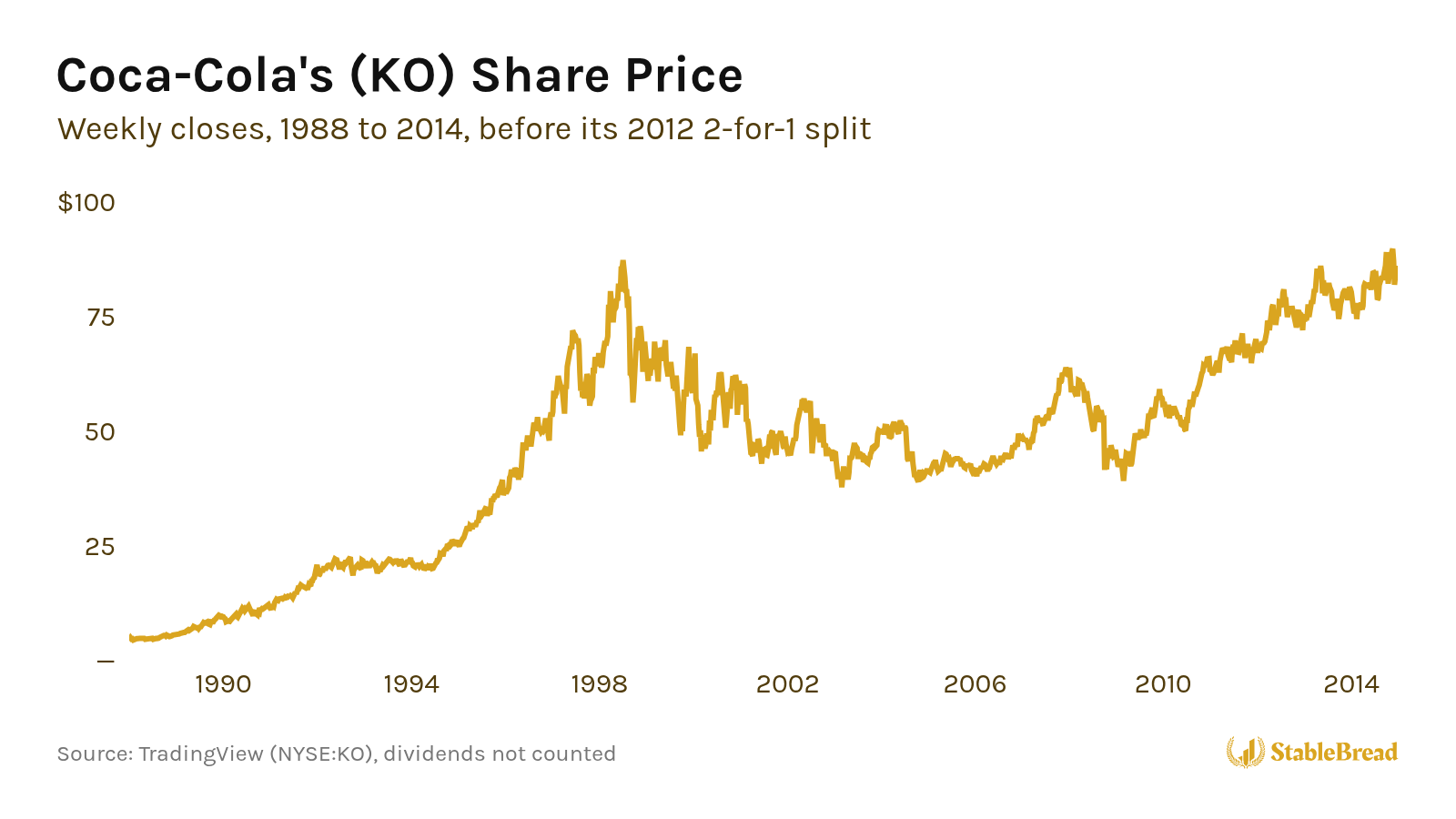
By the end of 2003, Berkshire’s Coca-Cola shares were worth $10.2B, and the stock didn’t get back to its 1998 high until 2014.
In his letter to shareholders for 2003, Buffett wrote that he’d made “a big mistake in not selling several of our larger holdings during The Great Bubble,” and Coca-Cola was the largest of those holdings.
So when does an investor whose favorite holding period is forever actually sell? In “The New Buffettology” (2002), Mary Buffett (Warren’s former daughter-in-law) and David Clark explain that Warren sells in four situations, and below, I’ll walk through each one:
- When a stock becomes overvalued compared to bonds.
- When a better opportunity comes along.
- When the business or its environment changes.
- When a target price is met.
Related: 12 Reasons to Sell a Stock (With Examples)
When Stocks Become Overvalued Relative to Bonds
To tell when a stock is overvalued compared to bonds, Buffett uses a simple calculation that Mary Buffett describes in The New Buffettology. The steps are:
- Estimate the company’s total earnings per share for the next 10 years.
- Calculate what you’d earn if you invested the price of one share in bonds instead.
If the bonds would earn more over those 10 years, the stock is overpriced, and selling makes sense.
Coca-Cola Example
Her example is Coca-Cola in 1998. Coke earned $1.42/share that year, and it had grown its earnings 12%/year over the previous decade. At that growth rate, a share of Coke would earn $24.88 in total over the next 10 years.
Now compare that with bonds. If you invested the same $88 in corporate bonds paying 6%, you’d earn $5.28/year, or $52.80 over 10 years:
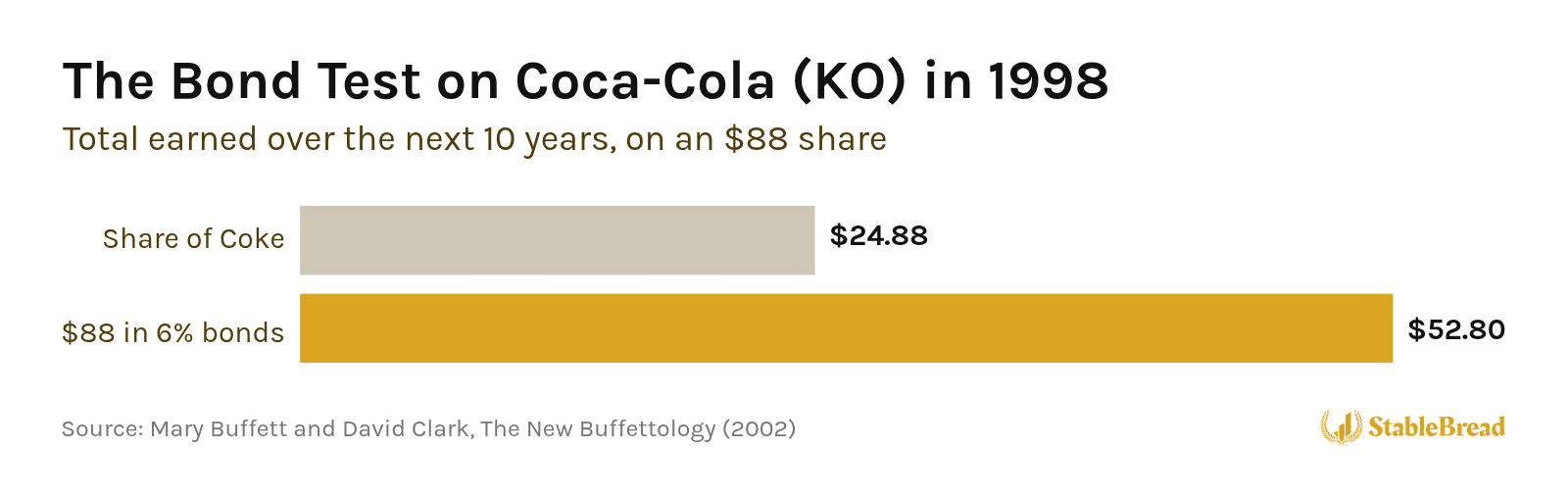
So would you rather earn $24.88 or $52.80 on your $88? The bonds would earn more than twice as much, which made Coke overpriced at $88.
Not to mention, corporate bonds are inherently less risky than stocks, because their interest is fixed and you get your $88 back when the bonds mature, while a stock’s earnings and price can both fall.
In fact, just to match the bonds, Coke’s earnings would’ve needed to grow ~27%/year, more than twice as fast as they had, or bond rates would’ve needed to fall below 3%.
At a lower price, the math flips. At $28.40/share (20x Coke’s earnings), the bonds would earn only $17 over 10 years, while the stock would still earn $24.88. So at that price, the stock is the better deal.
However, the bond test only tells you when a stock is too expensive. Sometimes the question is whether your money would grow faster in a different stock.
When Better Opportunities Emerge
Mary Buffett writes that Warren also sells when a more attractive opportunity comes along, as long as he’s trading up to a better business.
Buffett said something similar in that 1988 letter. He compared selling businesses that perform well while holding on to ones that disappoint to “cutting the flowers and watering the weeds,” a line from Peter Lynch, who ran Fidelity’s Magellan Fund.
So if you already own a company with a durable competitive advantage (an economic moat) and skilled management, Mary Buffett says to hold it until the market offers an extremely high price, and to ignore short-term price swings in the meantime.
Get Our 50-Question Stock Analysis Checklist!
After researching hundreds of stocks, we built this 50-question checklist to guide your analysis and help you avoid costly mistakes.
Download ChecklistBuffett and Bill Gates each built their fortunes that way, by holding one company’s stock for decades, Berkshire Hathaway for Buffett and Microsoft (MSFT) for Gates.
Trading in and out of stocks also tends to hurt returns. Brad Barber and Terrance Odean studied more than 66,000 households at a discount brokerage, and the 20% that traded the most earned 11.4%/year after costs from 1991 to 1996, while the stock market returned 17.9%/year:
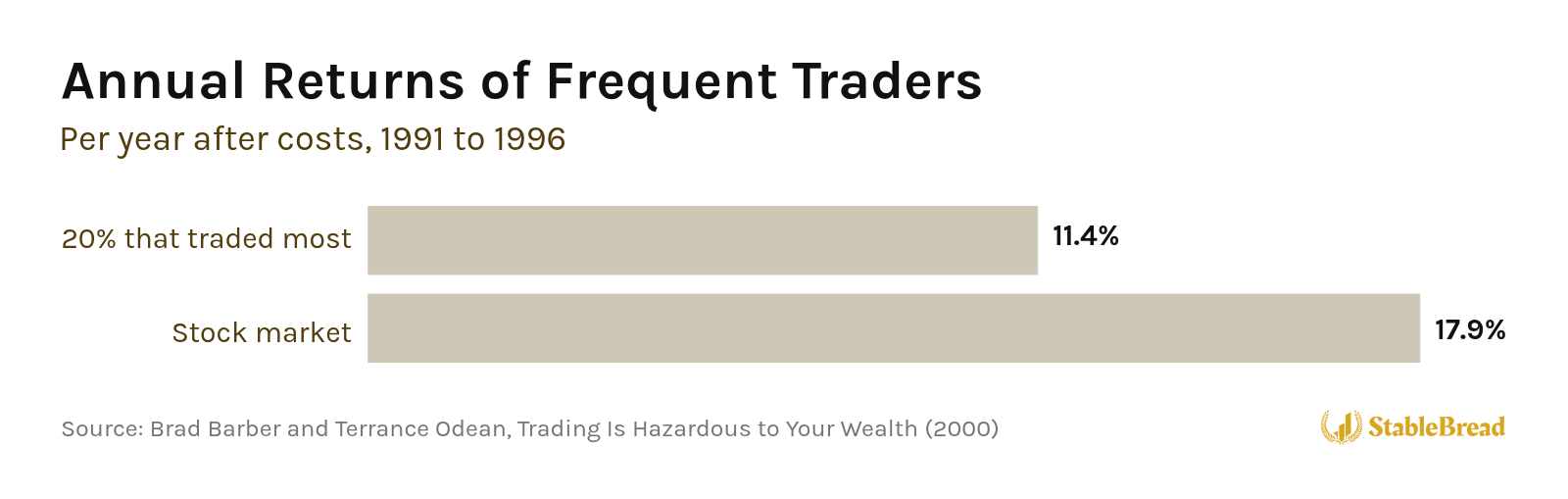
Frequent trading is one reason most investors underperform the market.
On the other hand, a business with no competitive advantage can tie up money that would grow faster somewhere else. So before you switch, ask whether you’re upgrading to a better business or just chasing the hottest stock.
True upgrades are rare, so with an exceptional business, patience is usually the best strategy. However, patience stops making sense when the business itself changes.
Related: Why You Should Run a Concentrated Portfolio
When the Business or Environment Changes
Buffett watches for changes that could turn a company with a durable competitive advantage into one that has to compete on price, or that could make it obsolete. When the economics of a business change, even a great company can become a poor investment.
At manufacturers and retailers, those changes tend to show up quickly in quarterly sales, when customers’ tastes shift or a new technology comes along. That gives you a chance to sell before the damage is permanent, as long as you act quickly.
Tesco: Selling Too Slowly
Tesco (TSCO), the U.K.’s largest grocer, is Buffett’s own example of acting too slowly.
At the end of 2012, Berkshire owned 415 million Tesco shares. In 2013, Buffett lost some confidence in Tesco’s management and sold 114 million shares, but he held on to the rest. He later wrote in his 2014 letter to shareholders:
“My leisurely pace in making sales would prove expensive.”
— Warren Buffett, Berkshire Hathaway’s 2014 Letter to Shareholders
During 2014, Tesco’s problems got worse by the month. Tesco’s market share fell, its margins shrank, and accounting problems came out.
As Buffett put it, “You see a cockroach in your kitchen. As the days go by, you meet his relatives.”
Berkshire sold its remaining Tesco shares that year, and its after-tax loss on the whole investment came to $444M.
COVID-19 and the Airlines
Some of the changes that make Buffett sell come from outside the business. In March 2020, COVID-19 shut down most air travel, and Delta Air Lines’ (DAL) 10-Q, its quarterly report for the quarter ended March 31, 2020, shows how fast that hit the airlines.
I pulled up the 10-Q in SECSift, the SEC filing reader I built. Delta wrote that demand for travel “declined at an accelerated pace.” For the June 2020 quarter, it planned to cut its international flying by ~90% and its domestic flying by ~80% from a year earlier, and it was parking about half of its planes.
By the end of April 2020, Berkshire had sold all of its shares in the four largest U.S. airlines (American, Delta, Southwest and United). When Buffett explained the sale at Berkshire’s annual meeting on May 2, 2020, he said, “The world has changed for the airlines.”
Banks, Insurers and Freddie Mac
Changes at banks and insurance companies are much harder to see, which makes banks and insurers riskier to own. Mary Buffett writes that Warren finds it almost impossible to spot trouble brewing at banks and insurers, because they can hide problems with accounting choices until a disaster suddenly appears.
That’s what happened at Freddie Mac (FMCC), the mortgage company Congress created in 1970. Freddie Mac buys home mortgages from lenders, bundles them into securities, and sells those securities to investors like pension funds.
When Berkshire bought its stake in 1988, Freddie Mac was a straightforward business Buffett understood, and its government sponsorship and its expertise in home mortgages gave it a competitive advantage.
However, by 2000, Freddie Mac’s management was promising to grow its earnings per share at a low double-digit rate, year after year. In a 2010 interview with the Financial Crisis Inquiry Commission, the panel Congress set up to investigate the 2008 crisis, Buffett said that “any time a large financial institution starts promising regular earnings increases, you’re going to have trouble.”
He was also troubled that Freddie Mac had made a large investment in a tobacco company’s bonds, which had nothing to do with housing. So in 2000, Berkshire sold nearly all of its Freddie Mac shares.
That proved to be the right decision, as Freddie Mac’s share price over the following decade shows:
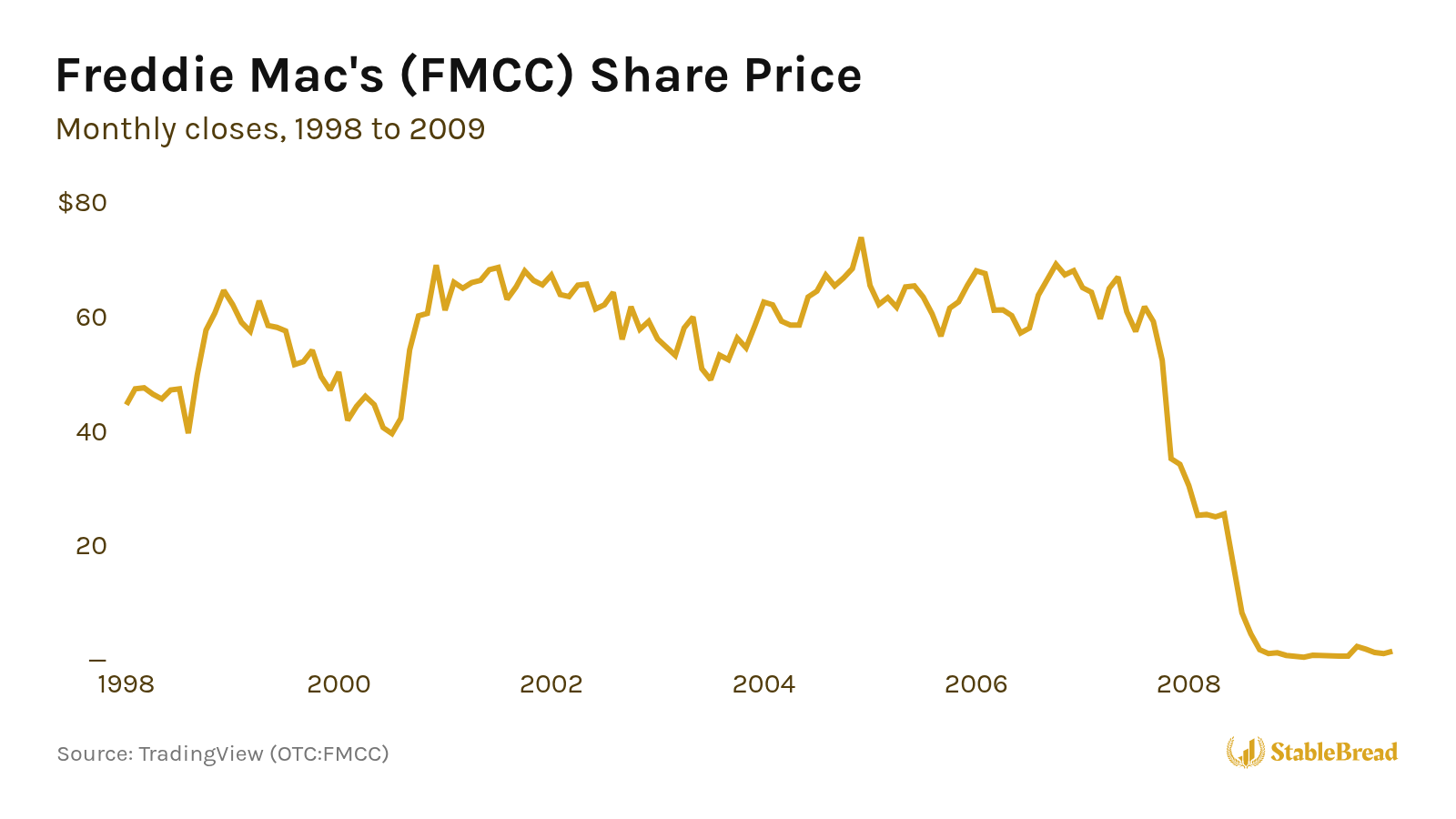
In 2003, Freddie Mac admitted it had used its accounting to smooth its earnings, and it had to restate $5B of past profits, according to the Congressional Research Service. Then in September 2008, during the housing crash, the U.S. government put Freddie Mac under its control, and Freddie Mac’s stock fell below $1.
When Target Prices Are Met
Buffett sets an exit price before buying some investments, based on a specific catalyst or valuation target.
All arbitrage situations fall into this category because they involve buying and selling to profit from a known price difference that will close at a specific time, like when a merger completes at an announced price.
Corporate Conversions
Buffett has also profited from companies converting from corporations into partnerships. According to Mary Buffett, in 1981, he bought shares of Tenneco Offshore, a natural gas producer that paid out all of its profits to its shareholders.
Tenneco planned to convert to a partnership to avoid double taxation:
- As a corporation: Tenneco earned $1.21/share but paid $0.41 in corporate taxes, leaving only $0.80 for dividends.
- As a partnership: Tenneco Offshore could pay out the full $1.21 to investors.
With Treasury bonds yielding 14%, investors valued dividend stocks by dividing the annual dividend by the bond rate. Tenneco’s $0.80 dividend meant the stock traded at $5.71/share ($0.80 / 14%). After converting, the $1.21 payout would justify a price of $8.64/share ($1.21 / 14%).
Those bigger payouts were also reliable. A partnership doesn’t pay taxes on its profits. Instead, the partnership’s owners pay those taxes every year, even on profits the partnership keeps, so a partnership usually pays out its profits to give its owners the cash for those taxes.
The market initially ignored the conversion announcement, allowing Buffett to buy at $5.71. After Tenneco converted, investors realized they’d receive $1.21/year instead of $0.80, and the stock rose to $8:
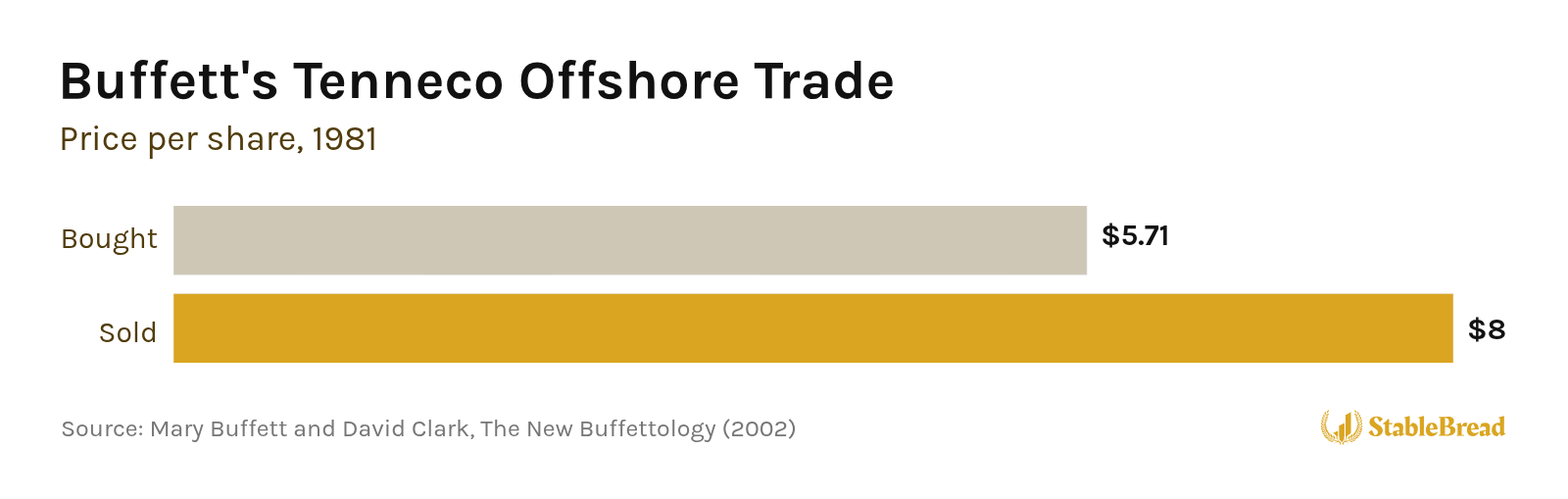
Buffett sold for a 40% gain. The conversion gave him a specific catalyst and a target price he could calculate, so he knew when he’d sell before he bought.
